
Custom Brass Jewelry: 100-Piece Minimums Explained
The number 100 is not arbitrary. Artisan eco-brass carries a MOQ of 100 pieces per design, 925 sterling silver carries 50, and stainless steel carries 100+ — a ladder that follows how much bench work each material needs before a single piece is finished. Everything a hundred pieces passes through is inspectable before it ships.

Key takeaways
- Minimum order quantities are 100 pcs in eco-brass, 100+ pcs in the stainless line and 50 in 925 sterling silver, by design.
- Brass carries the higher minimum because plating, polishing and coating are all per-piece bench work.
- A 100-piece order is 100 stone seats, 100 clasps and 100 packing cards, not just 100 castings.
- Inspection is published at 100% of pieces before packing, which is the last gate before shipping.
Where the hundred comes from
Minimums track the number of operations a piece passes through after casting. Silver is largely finished metal: it casts well, polishes easily and can be sold without a plating stack. Brass needs a coating to define its look, and stainless steel needs a different coating process and more machine time, which is why its minimum is stated as 100+ rather than 100.
The published ladder is therefore a cost statement rather than a policy. Each step up carries more hand work per piece, and more hand work has to be justified by a longer run.
Silver at 50, brass at 100, stainless at 100+
Fifty pieces per design is the silver figure. It is the lowest of the three because sterling silver can be finished and delivered without plating, which removes an entire sequence from the run. A brand with an untested design often starts here for exactly that reason.
Stainless steel sits above brass at 100+ because it runs through PVD vacuum plating rather than electroplating, a process with its own constraints. Between the two, brass at 100 is the middle rung: plated, but plated by a route the factory applies at scale.
Spreading a hundred pieces across a size run
The minimum applies per design, not per size. On a five-size ring run, 100 ÷ 5 = 20 pieces per size. On a four-size bracelet run, 100 ÷ 4 = 25 pieces per size. Nothing about the order changes; only how the pieces are distributed.
That distribution matters for a first order. Ten or twenty pieces per size can sit on a shelf for months, and the sell-through signal from the first size that clears tells you whether the design works. A narrow size curve produces that signal faster than a full one.
What a hundred pieces go through
Each piece is cast, sprue-cut, polished, surface-finished, plated and coated. Then it is inspected, paired with a clasp or chain, tagged and packed. On the packaging side the published components run to five: labelling with barcodes, backing cards, metallic logo tags, foil-stamped boxes and microfiber or velvet pouches.
Multiplying all of that by 100 is the real content of the minimum, and it is why the packaging spec should be settled at the CAD stage rather than the week before shipping. One printed card still missing holds an entire batch in its cartons.
Where inspection sits before anything ships
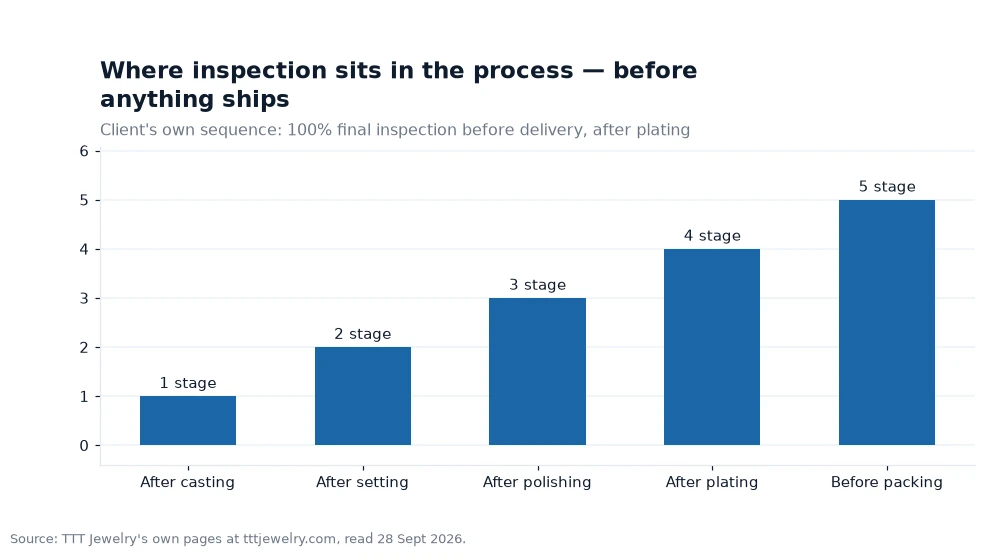
Inspection is not a single event at the end. The published process places checks around the major operations, with a 100% inspection before packing as the last one. That ordering means a defect is caught as close as possible to the operation that produced it.
For a brand ordering a custom brass jewelry OEM run, the practical request is the per-batch inspection record: which stage was checked, when, and what was held back. A supplier that produces that record quickly has a working quality system behind it.
What changes on a reorder
A reorder is cheaper to plan because nothing needs developing. The sample already exists, the specification is on file and the mould is cut, so the run sits inside the published 3–4 week production window with no sampling stage attached.
What does not change is the minimum. Reordering 40 pieces of a design to top up a single size is not an option at a 100-piece minimum, which is why it is worth ordering the sizes you expect to sell through rather than a perfect curve.
| Base material | MOQ per design | Why it sits there |
|---|---|---|
| 925 sterling silver | 50 pcs | No plating stack required to finish the piece |
| Artisan eco-brass | 100 pcs | Plating, polishing and anti-tarnish e-coating per piece |
| Stainless steel | 100+ pcs | PVD vacuum plating plus harder machining |
| Final inspection | 100% of pieces | Check before packing, not after shipping |
What the final check covers on the brass line
The brass line describes its last step as a 100% manual inspection and names what the check looks at: craft, finish, gem setting, size and structure. That is more specific than a pass figure, and it is the list an inspector should be held to.
Read against the chart below, it also explains why the check sits where it does. Craft and finish are judged after plating and the anti-tarnish pass; gem setting is judged on the assembled piece; size and structure are judged last, before jewelry-specific packaging and trackable shipping. One check covering all five is the final point at which a piece can be held back.
Two other statements from the same page matter when a first quantity is set. The alloy is described as a premium alloy of copper and zinc whose nickel content meets certified standards, and the brass itself is 100% recyclable — the wording the line uses for its own sustainability position.
Worked example: what the hundred-piece minimum buys you
Take three ring designs in artisan eco-brass at the minimum, on a five-size curve. Each design runs 100 pieces, so the order holds 3 × 100 = 300 pieces. Per size, the split is 3 × (100 ÷ 5) = 3 × 20 = 60 pieces across the range.
Now compare materials on the same design. Brass is 100 pieces and silver is 50, so the difference is 100 − 50 = 50 pieces per design — the extra inventory a plated line carries for the same design count.
Across three designs that gap is 3 × 50 = 150 pieces. Whether that is a fair trade depends on the price the plated piece sells at, but it should be a deliberate number rather than a surprise at the packing stage.
Frequently asked questions
Why is the brass minimum higher than the silver minimum?
Because a brass piece carries a plating stack, polishing and an anti-tarnish e-coating per unit, while sterling silver can be finished without plating.
Is the MOQ per design or per order?
Per design. Three designs at 100 pieces each is a 300-piece order, and the minimum applies to each design separately.
Are all pieces inspected before shipping?
Yes, the published process ends with a 100% inspection before packing, which is the final gate before delivery.
Sizing a first brass order properly
Work backwards from the size curve: decide the designs, divide the minimum across the sizes you can realistically sell, then fix the finish and packing spec before tooling. The two documents that make the run easy to plan are the OEM/ODM manufacturing page and the questions buyers ask before a first quantity is set.
The details quoted above — the REACH and California Prop 65 compliance and the anti-tarnish coating for silver as well as the gold and rhodium plating build — trace back to the manufacturer's published pages on tttjewelry.com's own pages, checked 28 Sept 2026. The chart's relative scale is mine alone — the site supplies the inputs only[1].